
Welcome Colorado River Basin to Risk and Adaptative Management administered with Interior discretion. Past approaches are in the dustbin. Gone are the days of multi-year formal policy commitments governing Colorado River management. Gone are the days of “staying the course” without assessments of the impact of policy actions within the context of the underlying uncertainty of future hydrology, economic and environmental conditions. This was inevitable.
Interior’s Preferred Alternative
Hydrowonk finds the final EIS thought-provoking. Past approaches specified triggers for how projected elevations at Lake Mead determined curtailments of Colorado River water deliveries in the Lower Basin and the Republic of Mexico. Interior abandons this framework. Instead, Interior presents principles and sideboards (“key thresholds and ranges for operational elements”) and “a process that would govern development and issuance of operating guidelines covering anticipated 2-year intervals.”
Does this shift reflect the fact that Interior is now involved in catastrophic risk management? In 2022, Reclamation warned about the prospect that under existing policy Colorado River system storage will decline to levels threatening hydropower production and eventually the prospect that Lake Powell and Lake Mead may reach Deadpool. After the past few years of initially ineffective action and later inaction by the Seven Basin States, has Interior shifted its framework to deciding operating decisions based on real-time information about the changing prospects of emerging catastrophic risks on the Colorado River?
Consider Interior’s operating principles that focus on protecting federal infrastructure (see table). Does the first principle mean that Reclamation will consider “mid-course corrections” even within a year if actual elevations materially diverge from projected elevations of Lake Powell and Lake Mead? Probably. Does the second principle suggest triggers for Reclamation going back to the drawing board for new ideas when elevation falls to the triggers? Does the third principle contain a dose of asserting “emergency powers”? Pending a Seven Basin State buy-in, hasn’t the “federal train” left the station with an emphasis on Interior protecting federal infrastructure? This is now Hydrowonk reads the “tea leaves.”
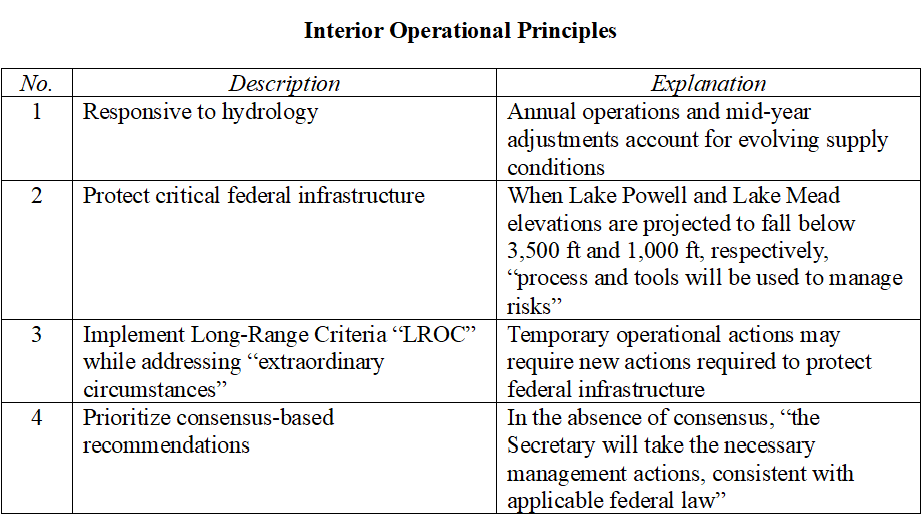
Interior, of course, also considers Colorado River water supply reliability (risk, magnitude and duration of curtailments—although not clear enough given Hydrowonk’s risk management principles). Presumably, the costs of shortages are to be properly managed, minimized but not necessarily eliminated given the necessary protection federal infrastructure.
Pay Attention to the Record of Decision
The Record of Decision (“ROD”) warrants unprecedented scrutiny. Will it provide the pathway for continuing consultations among willing parties based on:
(i) analytic investigations of facts on the ground,
(ii) reasonable expectations about the future
(iii) a daunting drill (every morning?) thinking through the consequences of alternative courses of future actions
(iv) monitoring in real time whether the “road map” shaping federal decision-making needs re-routing.
Such dialogue could provide a continuing opportunity for Interior to secure real-time input from interested parties as it navigates the hydrologic and policy challenges of the Colorado River.
Subsequence posts will address the challenges Interior faces in implementing proper risk management tools, navigating the economic consequences of its actions, obtaining necessary Department of State approval for how Interior modeled US Colorado River water treaty obligations with Mexico.