
Nevada Fires First Volley in Colorado River Litigation Lottery
On August 24, 2026, Nevada filed a complaint with the US District Court for the State of Nevada seeking declaratory and injunctive relief challenging Interior’s implementation of its Record of Decision regarding the management of the Colorado River. It argues that Interior’s policy violates the Administrative Procedures Act, National Environmental Policy Act and the Law of the River.
Nevada complains that Interior did not select the Lower Basin States proposal that Nevada maintains “fully complies with the Law of the River and better satisfies the purpose and need of the proposed (federal) action than the preferred alternative in the Final EIS. Federal Defendants failed to consider and carry forward the Lower Basin States’ alternative.”
The core often unspoken premises of Nevada’s claims may prove daunting for the judiciary.
The Law of the River
After referencing the original annual apportionment of 7.5 million AF of Colorado River to the Upper and Lower Basins, Nevada states:
The Compact has two additional provisions that impact the Upper Basin allocation. First, the Upper Basin must supply one half of the United States’ obligation to the Republic of Mexico (750,000 afy) when there is insufficient surplus water over and above amounts allocated to the Upper and Lower Basin under the Compact. Second, “[t]he States of the Upper [Basin] will not cause the flow of the river at Lee Ferry to be depleted below an aggregate of 75,000,000 acre-feet [75 maf] for any period of ten consecutive years.” “(P)rovided there is insufficient surplus water in the system to fully satisfy the obligation to Mexico, the Lower Basin States have the authority to make a ‘compact call,’ i.e., request that the Upper Basin take actions necessary to ensure that not less than 82.5 maf flow past Lee Ferry in any 10-year period. (emphasis added)
Hydrowonk agrees as far as it goes.
But the complaint neglects the impact of the 1944 Treaty on the Lower Basin’s annual apportionment. Without a sufficient surplus of water to fully satisfy the obligation to Mexico, the Lower Basin must supply the other half of the United States’ obligation to the Republic of Mexico. The Lower Basin’s annual apportionment is 6.75 maf (8.25 maf – 1.5 maf), not 7.5 maf. For discussion, see What Is the Plan Meeting of the 1922 Colorado River Compact.
Lower Basin’s Overuse of Colorado River Water
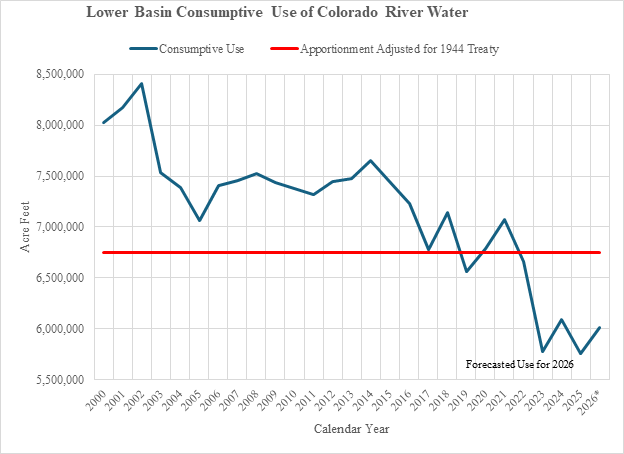
The “Colorado River mantra” of key players is that the Colorado River has experienced unprecedented drought since 2000, as though that was the only problem. The consumptive use of Colorado River water in the Lower Basin has regularly exceeded its adjusted annual apportionment (see chart). Until the implementation of the Quantification Settlement Agreement (“QSA”) in 2003, California’s annual consumptive use was on the order of 5.2 maf, or 0.8 maf above California’s 4.4 maf apportionment. Although California finally complied with its 4.4 maf apportionment since QSA implementation (mainly due to voluntary agreements among key players), the Lower Basin’s total consumptive use of Colorado River water routinely exceeded its adjusted apportionment until 2022, when the Biden Administration announced the federal government’s intention to enforce reductions in the use of Colorado River water. For discussion, see Colorado River in Disarray. Rather than rewarding good behaviors ultimately prevailing in the QSA transactions, the Lower Basin’s reduced consumptive use of Colorado River water was federally funded.
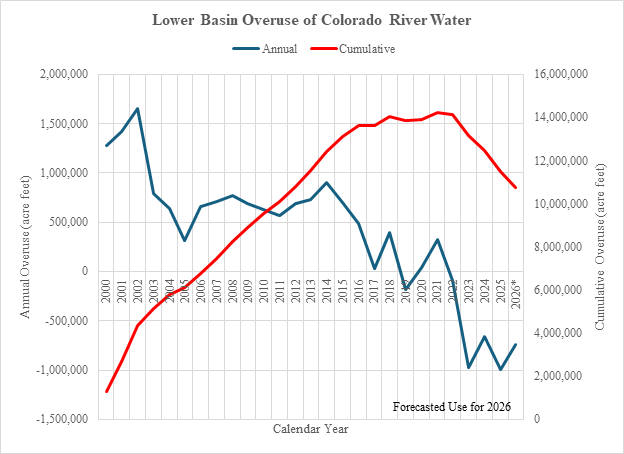
The reductions in the consumptive use of Colorado River water since 2023 “bent the curve” of rapidly increasing cumulative overuse of Colorado River in the Lower Basin (see chart). Cumulative overuse of Colorado River water since 2000 peaked above 14 maf by 2022 and now stands at 10.7 maf this year. A five-year “payback” of the outstanding cumulative overuse would require the Lower Basin to reduce its annual consumptive use by 2.14 maf, putting the Lower Basin’s annual consumptive use of Colorado River water at 4.61 maf (6.75 maf – 2.14 maf) through 2031.
Nevada Has Reduced Its Use of Colorado River Water but Remains Vulnerable to Water Shortages
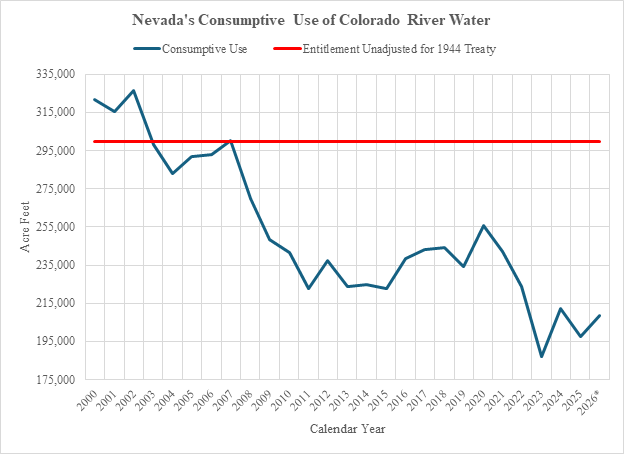
Before 2008, Nevada’s consumptive use of Colorado River water hovered around its 300,000 AF apportionment (unadjusted for the 1944 treaty), see chart. The 2008 housing downturn and Southern Nevada Water Authority’s water conservation programs reduced Nevada’s consumptive use of Colorado River water to 235,000 AF by 2022. Since then, Nevada’s annual consumptive use of Colorado River water has averaged 201,351 AF.
Nevada faces significant risks of water shortages under the priority system. Nevada generally has little present perfected rights under Arizona v. California and junior priority dates to Colorado River water (see Bureau document Listing of Individual Colorado River Entitlements in the State of Nevada, June 2025). Other key players face similar fates.
Socioeconomic Impacts
Nevada argues “(a)bsent from the Final EIS is any evaluation of the reasonably foreseeable direct, indirect, or cumulative socioeconomic effects to municipal water users or municipal water agencies from decreased supply and water shortages. It contains no analysis of the very real and dire economic effects to millions of municipal water users if the taps are turned off or water use must be significantly curtailed.”
Hydrowonk agrees that water shortages have economic consequences. But this has long been known by all parties, dating back to the successful QSA agreements. The question has never been whether water shortages have socioeconomic impacts, but what are the solutions and who should pay.
Unsurprising to some, Interior’s policy follows the priority system in its allocation decisions, with deference to allocations included in voluntary agreements among Lower Basin States. Hope that the federal government will either mandate or pay to address the socioeconomic impacts of water shortages is naturally shared by other users that have for decades made the conscious decision to ignore the law and, instead, play litigation lotteries.
Misguided Litigation?
The 2027 water year is weeks away. The Colorado River system must be managed facing the reality of available Colorado River water, existing hydrology and unprecedented low water storage. What guides the management of the Colorado River if a court sets aside Interior’s policy?
Will Nevada win the Powerball? Probably not. But without this kind of pressure and demand for legal clarification, key players are likely to continue the same political behaviors that created the crisis in the first place.
Suppose a prediction market posed the following question:
Will Nevada obtain a temporary restraining order against implementation of Interior’s Colorado River Policy by September 30, 2026?
Hydrowonk knows what side of the trade he would be on. What about you?