
Hydrowonk observed the Bureau’s January 29, 2026, presentation of the draft EIS for post-2026 operations. Three highlights of an outstanding presentation:
responsible risk management
adaptative management in future Bureau operational policies
the Bureau sets “rules of the road”, water users decide how to respond to water supply risks
From Hydrowonk’s perspective (see Is the Colorado River Basin Bankrupt?), the Bureau is on the right pathway, although there are a few outstanding potential pitfalls.
Welcome to Responsible Risk Management,
The Bureau examined the Colorado River’s future under five scenarios (a no action scenario and four alternatives) utilizing Decision-Making under Deep Uncertainty (“DMDU”). DMDU is a framework for choosing policies when there is disagreement on how the world works, the time path and statistical variability in key drivers (such as hydrology and economic development), future likelihoods, disagreement on policy objectives and trade-offs, and path dependency (today’s choices shape tomorrow’s circumstances).
In other words, DMDU is an excellent framework for analyzing the Colorado River’s future. In describing its approach, the Bureau mentioned that they have been working on this framework for more than a decade.
The draft EIS stress-tests alternatives across thousands of plausible futures. It examines how alternatives avoid catastrophic failure over wide range of future circumstances. Its analysis focuses on robustness and vulnerability, determining where alternatives fail and how badly. See table for High Level Performance Metrics used in the Bureau’s assessment of the alternatives.
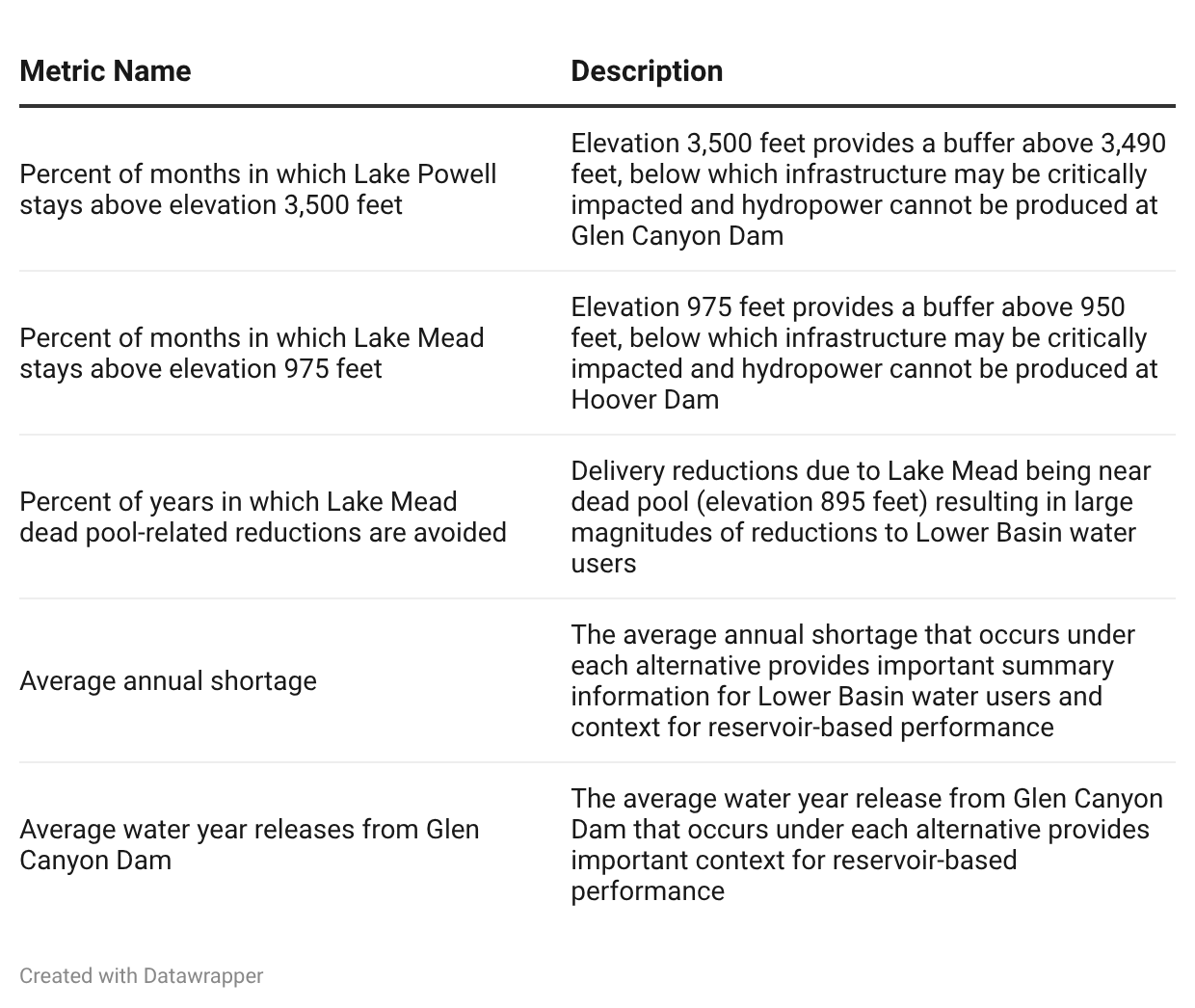
Anticipate a Bureau post-2026 operations policy that works “well enough” across many plausible futures. A comprehensive plan should include dynamic adaptative policy pathways (defining indicators of the need to switch policy) and set criteria for determining “how wrong” must the policy be for it to become unacceptable.
Welcome to Adaptative Management
The Bureau signaled the inevitable role of adaptative management. The post-2026 operations policy may have a short term (20 years or less). Discussion of operational alternatives states implementation “adjusted as necessary.”
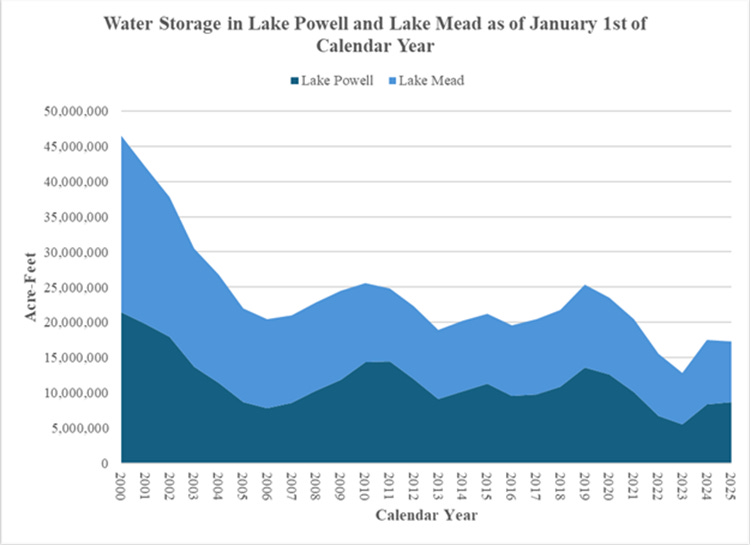
The prospect that post-2026 operations are subject to adaptative management is an improvement over pre-2026 operations. The volume of water in storage at Lake Powell and Lake Mead has been in freefall for 25 years (see chart). Shortage provisions initiated in 2007, followed by the 2019 Drought Contingency Plan, did not reverse the declining trend. By 2022, the Colorado River was in disarray. Long-term reliance on ineffective policy is a recipe for disaster.
Welcome to Water Users Being Responsible for Managing Water Risks
The Bureau received a question whether the EIS will analyze how new water supplies, such as desalination, would address water shortages. The Bureau’s answered “no.” Hydrowonk supports the Bureau.
The post-2026 operations will set the “rules of the road” for Bureau declarations of available Colorado River water, given the Law of the River. Water users are responsible for how they respond. Incur water shortages? Invest in new water supplies? Change water resource management? Enter into voluntary transfer agreements with senior water users?
The Bureau could regularly update anticipated availability of Colorado River water. Currently, the Bureau’s five-year probabilistic projections serve this role. The post-2026 operations will become the new framework for determining water availability. The quantification of curtailment risks for basin states could be based on the updated “risk ensemble” included in the Bureau’s assessments. Water users can incorporate the Bureau’s risk assessment into their decision-making about how best to manage their curtailment risk of their Colorado River water supplies.
Potential Pitfalls
The “dialogue” among the basin states and interested parties includes potential pitfalls.
Maintain Priority. The alternatives identified in the draft EIS generally follow some adherence to the priority system, with hybrid alternatives including some role for pro rata reductions. Allocation decisions conflicting with federal law and contractual provisions are an invitation for litigation lotteries.
Avoid Misapplication of Evaporation/System Losses. Recognizing evaporation and system losses is part and parcel of the existing water rights regime, although not as contemplated by some interests. By impacting the volume of available water, evaporation losses reduce the volume of available water apportioned under the priority system. Regarding system delivery losses, water delivery contracts specify delivery points for a defined quantity of Colorado River water. Bureau uses available water to meet its delivery obligations and absorb system delivery losses.
Embrace Shortage Sharing Article of 1944 Treaty. Article 10(b) contemplates shortage sharing between the United States and Mexico triggered by infrastructure failure or drought. The Colorado River water allocated to Mexico “will be reduced in the same proportion as consumptive uses in the United States are reduced.” Any post-2026 policy reducing Mexico’s 1.5-million-acre-foot of Colorado River water delivered at the border not equal to the reduction of consumptive use in the United States would be inconsistent with the 1944 Treaty. This position, of course, does not prevent voluntary agreements to further reduce the consumptive use of Colorado River in Mexico with acceptable compensation.
Next Steps
Can the Colorado River Basin states reach a consensus on proposed post-2026 operations by February 14, 2026? We will know soon. Without consensus, the Bureau will select its own preferred alternative in its Record of Decision. With consensus, the Bureau has another alternative to assess in selecting its preferred alternative. In the end, count on the Bureau to have the tools for selecting a preferred alternative that represents prudent risk management of the Colorado River for the United States and Mexico.