
What is the Plain Meaning of the 1922 Colorado River Compact: The Sequel
Hydrowonk follows up on his earlier post What is the Plain Meaning of the 1922 Colorado River Compact and What to Do About It. Channeling the wisdom of one of his many mentors (“Nino”) from University of Chicago Law and Economics crowd in the late-1970s, the belief that the Upper Basin guarantees the flows stated in Article III(d) of the 1922 Compact is not consistent with the plain meaning of the language. There is a “causation standard”, not a guarantee.
Did the Upper Basin cause the flow of the river at Lee Ferry to be depleted below an aggregate of 75 million acre-feet (“maf”) over the recent 10-year period. Nope. Hydrology will.
A Lower Basin colleague asked Hydrowonk whether Article III(d) of the 1922 Compact contains a “priority provision” in favor of the Lower Basin. Nino says no. Article III(d) has a causation standard with no mention of priority.
The Impact of the 1944 Treaty on Basin Apportionments
Other provisions of Article III of the 1922 Compact warrant consultation:
Article III(a): the original 7.5 maf apportionment of Colorado River water to each basin.
Article III(b): “the Lower Basin is hereby given the right to increase its beneficial consumptive use of such waters by one million acre-feet per annum.”
Article III(c): “If, as a matter of international comity, the United States of America shall hereinafter recognize in the United States of Mexico any right to the use of any waters of the Colorado River System, such waters shall be supplied first from the waters which are surplus over the above the aggregate of the quantities specified in paragraphs (a) and (b); and if such surplus shall prove insufficient for this purpose, then, the burden of such deficiency shall be equally borne by the Upper Basin and the Lower Basin, and whenever necessary the States of the Upper Division shall deliver at Lee Ferry water to supply one-half of the deficiency so recognized in addition to that provided in paragraph (d).” (emphasis added).
A key question posed by Article III(c) is: are there any surplus Colorado River water available to meet United States’ treaty obligation to Mexico? Not this century.
The Colorado River’s natural flows since 1922 have stubbornly moved toward long-term tree-ring estimates (see figure). Since the Great Depression, the 10-year running average of the annual natural flow of the Colorado River at Lees Ferry has hovered at or below 14.3 million acre-feet, except during the 1980s and a short bubble in the 1990s. During the 1980s, the United States delivered “excess flows” to Mexico when historic floods overran water storage on the Colorado River. Pending the arrival of the next historic flood (once every fifty or hundred years?), the average annual natural flow of the Colorado River will fluctuate around 14.3 million acre-feet and likely decline in the future. The shorter-lived bubble in the 1990s coincided with the time a major junior water right holder in California imagined surplus water on the Colorado River for “as long as the eye can see.” Fooled by randomness.
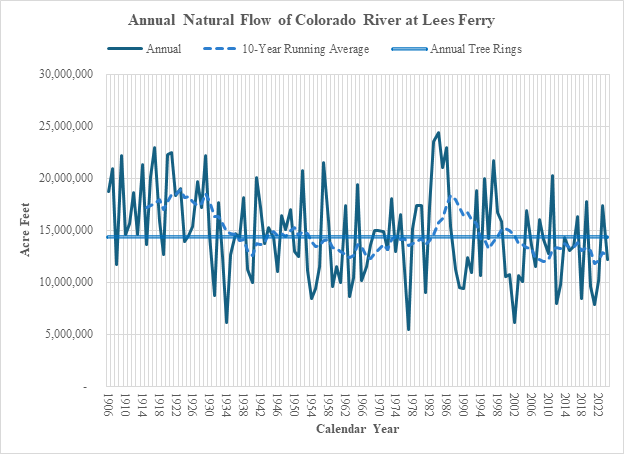
Reflecting drought conditions, the 10-Year Running average of the natural flow of the Colorado River at Lee Ferry has been below 14.3 maf since the early 2000s and substantially below the 16.5 maf threshold required to avoid the “equal burden” sharing for the basins for the 1944 Treaty apportionment to Mexico as specified in Article III(c).
This burden sharing requires the Upper Basin to deliver an average annual 8.25 maf of Colorado River water to the Lower Basin (7.5 maf + 0.75 maf). The adjusted Upper Basin apportionment is 6.75 maf (7.5 maf – 0.75 maf). With 8.25 maf from the Upper Basin, the Lower Basin would have 6.75 maf available of Colorado River water (after delivery of 1.5 maf of Colorado River to Mexico). With only 14.3 maf of annual Colorado River water available, this leaves the Upper Basin with an apportionment of 6.05 maf of Colorado River water (14.3 maf – 8.25 maf), assuming an asserted Lower Basin priority absent from the plain language of the 1922 Compact.
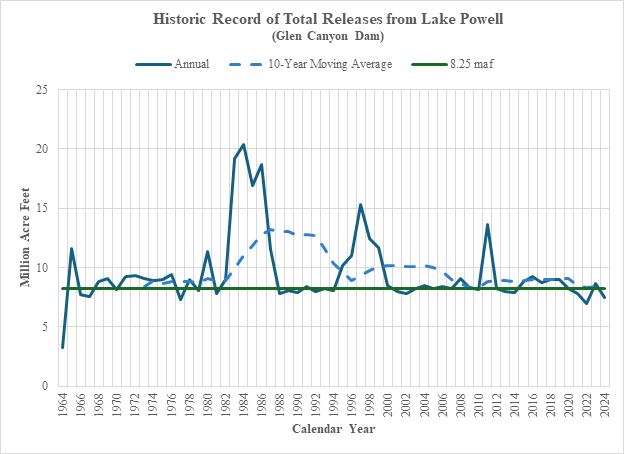
The historic record shows the 10-year running average of Total Releases from Lake Powell have met or exceeded the 8.25 maf threshold (see figure). The 10-year running average spiked above the 8.25 maf threshold during the historic floods on the Colorado River in the 1980s, as well as the “bubble” in the 1990s.
The recent historic record of Upper Basin Consumptive Use and Losses since 2016 have averaged 4,472 TAF (“thousand acre-feet”), or 74% of the Upper Basin adjusted 6.05 maf apportionment described above (see figure). Even with the long-term natural flow of the Colorado River converging to 14.3 maf, there is 1.578 maf (6.050 maf – 4.472 maf) “headroom” for long term growth in the use of Colorado River water in the Upper Basin under implementation of 1922 Colorado River Compact. The economic viability of expanded use of Colorado River water in the Upper Basin will depend on the effectiveness of storage policies to firm up the reliability of available Colorado River water supplies.
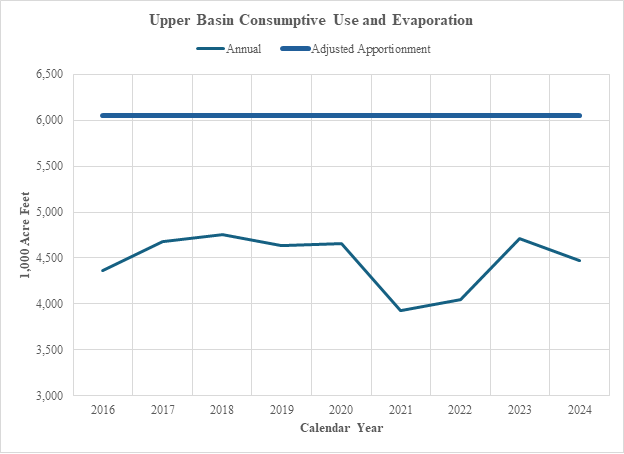
In other words, even if Lower Basin’s apportionment (adjusted for its burden for the US 1944 treaty obligation) of 6.75 maf has some form of “priority” not included in the plain language of the 1922 Compact, the Upper Basin still has “headroom” for expanded use of Colorado River water and the Lower Basin has exceeded its apportionment for at least 25 years.
Here is an updated Hydrowonk proposal for addressing the calamity on the Colorado River. First, the Lower Basin use of Colorado River water cannot exceed its adjusted apportionment of 6.75 maf. Second, follow Article 10(b) of the 1944 Treaty between the United States and Mexico where the reduction in deliveries to Mexico must be reduced in the same proportion as consumptive uses in the United States. So, if limiting the Lower Basin use to 6.75 maf is insufficient, why not reduce the consumptive use of the Upper Basin and further reductions in Lower Basin use below 6.75 maf by the same proportion, pending an alternative agreement between the basins?